Best Educational Bird Feeders for Schools: 3 Options That Teach and Entertain
You set up a bird feeder outside the classroom window. A cardinal lands. Twenty kids go quiet — all of them leaning forward, staring.
That is a better nature lesson than any textbook page.
The right
educational bird feeder for schools does more than feed birds. It gives students daily, hands-on contact with local wildlife. It teaches species identification, animal behavior, seasonal patterns, and ecosystems — all without a field trip.
But which feeder is right for a school setting? You need something durable, easy for staff to maintain, and engaging enough to hold a child’s attention week after week.
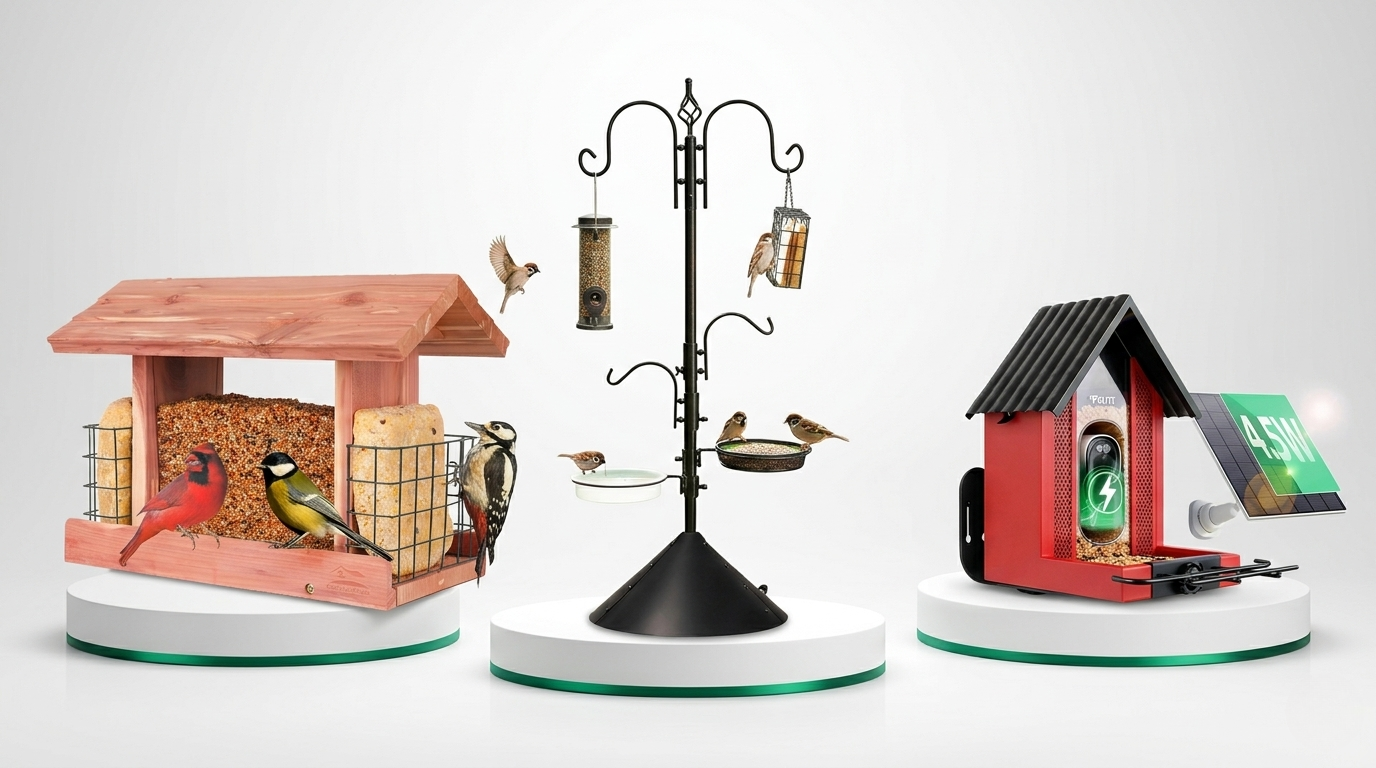
I reviewed three products that fit the bill — each with a different strength. One is a multi-feeder station with squirrel protection. One is a solar-powered smart feeder with AI bird identification. One is a handcrafted cedar hopper that introduces students to natural materials and woodcraft.
Here is the honest breakdown of all three.
Quick Comparison Table
| Product |
Price |
Rating |
Best For |
Key Feature |
| ERYTLLY Feeding Station Kit |
$45.99 |
4.0/5 (523 reviews) |
Schoolyards, science gardens |
91″ tall, multi-feeder pole, squirrel baffle |
| BOLITE Smart Feeder with Camera |
$55.99 |
4.8/5 (13 reviews) |
Tech-integrated classrooms |
2.5K HD camera, AI species ID, solar power |
| Solution4Patio Cedar Hopper Feeder |
$36.99 |
4.4/5 (2,578 reviews) |
Nature-based learning, all ages |
Handcrafted cedar wood, double suet cage |
ERYTLLY Bird Feeding Station Kit

Best Educational Bird Feeder for School Gardens and Science Projects
Picture a school garden. A tall pole stands in the center. Five different feeders hang at different heights. Cardinals and finches take turns. Students sketch what they see from the classroom window.
That is exactly what the ERYTLLY Bird Feeding Station Kit makes possible.
This is not a single feeder. It is a full feeding station — a 91-inch metal pole with multiple hooks, a mesh tray, a tube seed feeder, a suet cage, a water dish, and a squirrel guard baffle. It is the kind of setup that turns a bare corner of the school garden into a working wildlife observation station.
Over
300 units sold last month. It holds a
4.0-star rating from 523 verified buyers on Amazon, ranked
#77 in Wild Bird Feeders.
Why Schools Choose Multi-Station Feeders
A single feeder attracts one type of bird. A multi-station setup attracts many species at once.
Cardinals prefer platform trays and open feeders. Finches favor tube feeders. Woodpeckers go straight for the suet cage. By having all three options on one pole, you give students the chance to observe how different species prefer different food and different feeder heights — a lesson in habitat ecology built into one product.
One buyer described setting it up just before major windstorms hit California. The feeder did not move. Another buyer assembled it in 30 minutes and had birds checking it out within minutes of installation.
Key Features
| Feature |
Details |
| Brand |
ERYTLLY |
| Height |
91 inches (7.5 feet) |
| Material |
Alloy Steel + Plastic |
| Included feeders |
Tube seed feeder, mesh tray, suet cage, water dish |
| Hooks |
4 large hooks for additional feeders |
| Special features |
Rust-resistant, squirrel-proof baffle |
| Target birds |
Cardinal, Chickadee, Dove, Finch, Hummingbird, Junco, Nuthatch, Robin, Sparrow, Woodpecker |
| Amazon rank |
#77 in Wild Bird Feeders |
| Price |
$45.99 (30% off list price) |
Classroom Learning Activities This Enables
- Species identification: Students log which birds use which feeder each day
- Behavioral observation: Which birds share space? Which don’t? Why?
- Seasonal tracking: Which species appear in winter vs. spring?
- Food science: What seeds attract which birds and why?
- Math integration: Track visit frequency and graph results over a school term
Honest Pros and Cons
Pros
- Complete all-in-one station — no need to buy separate feeders
- 91-inch height keeps feeders visible from a classroom window
- 4 adjustable hooks fit additional feeders you already own
- Squirrel baffle included and tested — works when positioned correctly (mount at 4 feet off the ground)
- Mesh tray and water dish offer variety for different bird species
- Easy to adjust height by loosening the wing nuts
- 5 ground prongs add stability — no tools needed to install
- Good value at $45.99 for a complete station
- Rust-resistant alloy steel holds up through seasons
- Great gift option for school nature programs and science departments
Cons
- The squirrel baffle is plastic and tricky to assemble — sharp edges reported by some users; adult assembly recommended
- Powder coating can chip around screw holes over time, leading to minor rust spots — apply a little Rust-Oleum if this happens
- The mesh tray is not removable without unscrewing the pole — harder to clean than ideal for school settings
- Ground stakes may not be long enough in loose or sandy soil — a strong wind can tip it over if not secured properly
- Not for very small birds only — perch size suits small-to-medium birds best
- Some units arrived with minor packaging damage; check on delivery
The Honest Truth About Squirrel Protection
Some buyers say the baffle works perfectly. Others say their squirrels found a way around it within minutes. The difference comes down to placement.
Mount the baffle at exactly 4 feet above the ground. Keep the pole at least 10 feet from fences, trees, sheds, or anything a squirrel can jump from. Do both, and most squirrels give up. Ignore either rule, and squirrels will treat the baffle as a step stool.
→ Check the latest price on Amazon
BOLITE Smart Bird Feeder with Camera (2.5K HD)

Best Educational Bird Feeder for Tech-Integrated Classrooms
What if the bird feeder was also a live camera that identified every bird that landed on it — automatically?
The BOLITE Smart Bird Feeder does exactly that. It is a solar-powered bird feeder with a
2.5K HD camera, built-in AI that identifies over
10,000 bird species, motion detection, two-way audio, and a companion app that sends your phone an alert every time a bird arrives.
For STEM programs, science clubs, or any classroom that uses technology as a learning tool, this feeder is in a category of its own.
It holds a
4.8-star rating from 13 verified buyers — a newer product with a small but very enthusiastic early user base. One buyer called it “National Geographic in your backyard.” Another bought one for elderly parents who love watching birds from their living room.
Why This Works in a School Setting
Most bird feeders require students to sit and wait. The BOLITE changes the dynamic. The app sends a notification the moment a bird lands. Students can review recorded footage. The AI tells them exactly what species visited. They can build a documented species list over weeks and months — a living data set.
One buyer integrated the camera feed into Home Assistant for a custom dashboard. For a tech class or coding elective, that level of customization makes it a legitimate teaching tool beyond just bird watching.
Key Features
| Feature |
Details |
| Brand |
BOLITE |
| Camera |
2.5K HD, 130° wide-angle |
| Power |
Solar (4W panel) + 5200mAh rechargeable battery |
| Storage |
64GB SD card included |
| AI features |
Identifies 10,000+ bird species, motion detection, instant app alerts |
| Audio |
Built-in mic and speaker (two-way) |
| Capacity |
1.8 liters |
| Mounting |
Wall, pole, or tree (freestanding capable) |
| Connectivity |
2.4GHz WiFi |
| Price |
$55.99 |
Classroom Learning Activities This Enables
- Real-time species identification: AI names every bird the moment it lands
- Data collection: App logs visit times, species, and frequency
- Video documentation: Students review footage to study feeding behavior
- Live streaming: Show the feeder feed on a classroom projector in real time
- STEM integration: Explore solar energy, AI technology, and wildlife science in one device
- Cross-classroom sharing: Students in different schools or cities can share their bird lists
Honest Pros and Cons
Pros
- 2.5K HD video — sharp enough to see individual feathers up close
- AI identifies 10,000+ bird species automatically — no field guide needed
- Solar powered — no batteries to change, no wires to run
- 64GB SD card included — no immediate subscription required for storage
- Motion detection sends instant alerts to the teacher’s or student’s phone
- Two-way audio lets students hear bird calls in real time
- Durable metal frame (despite “plastic” listed in specs — confirmed by multiple buyers)
- Multiple mounting options — versatile for different school setups
- Came with birds visiting within 24 hours for some buyers (faster than the typical 2–3 week timeline)
- Doubles as a yard security camera when birds are not present
Cons
- AI bird species identification requires a paid subscription — free tier uses motion detection only
- App pushes cloud storage upgrades frequently — not ideal for younger students navigating it solo
- Only supports 2.4GHz WiFi — will not connect to 5GHz networks
- Camera must be physically removed from feeder to turn it on initially — slightly awkward setup
- Food capacity (1.8L) is smaller than traditional feeders — more frequent refills needed with heavy bird traffic
- Solar panel mount designed for wood surfaces only — extra work to mount on metal poles (zip tie solution confirmed by users)
- App is functional but not the most intuitive — plan 20–30 minutes for initial setup
- Blue indicator light on the camera cannot be turned off — minor annoyance in some placements
- Newer product with fewer reviews (13 total) — less long-term durability data available
→ Check the latest price on Amazon
Solution4Patio US Cedar Hopper Bird Feeder


Best Educational Bird Feeder for Nature-Based Learning and All Ages
Some lessons do not need technology. Sometimes the best classroom tool is a piece of cedar wood, a handful of seeds, and an open window.
The Solution4Patio Cedar Hopper Bird Feeder is handcrafted from US cedar — the same aromatic wood that naturally repels pests and weathers seasons without rotting. It holds seed in a central hopper, has two suet cages on either side, and features clear view windows so birds can see the seed and students can see the birds.
It holds a
4.4-star rating from 2,578 verified buyers — the most reviewed product in this comparison — ranked
#152 in Wild Bird Feeders with over 200 units sold per month.
This feeder works especially well for younger students. It connects directly to concepts like natural materials, woodworking, wildlife habitat, and sustainable materials sourcing. The cedar smell alone is a conversation starter.
Why Cedar Makes a Difference for Schools
Cedar is not just beautiful. It is practical. The natural oils in cedar wood repel insects and resist moisture without chemical treatment. This matters in a school garden where students may touch or handle the feeder.
One buyer called it “the best feeder I’ve been able to find in six years.” Another noted that woodpeckers — including large pileated woodpeckers — regularly use the suet cages. A third survived a bad storm with heavy wind and found it still hanging with no damage.
Key Features
| Feature |
Details |
| Brand |
Solution4Patio |
| Material |
US Cedar wood |
| Style |
Rectangle hopper (Hexagon Gazebo also available) |
| Capacity |
2.35 liters (approx. 2.5 lbs of seed — note: product description claims 5 lbs, real capacity is about half that) |
| Suet cages |
Double — one on each side |
| Mounting |
Hanging mount |
| Target birds |
Blue Jay, Cardinal, Finch, Chickadee, Woodpecker |
| Special features |
Squirrel-proof design, clear view windows, gravity-fed seed flow |
| Weight |
3.2 lbs |
| Price |
$36.99 |
Classroom Learning Activities This Enables
- Natural materials lesson: What is cedar? Why do we use it for outdoor products?
- Ecosystem mapping: Which birds eat seeds vs. suet? What does that tell us about their diet?
- Gravity and physics: How does a gravity-fed hopper dispense food automatically?
- Art and nature journaling: Students sketch the feeder and the birds it attracts
- Seasonal science: Do the same birds visit in winter and summer? Why or why not?
- Math and measurement: How long does 2.5 lbs of seed last with different bird populations?
Honest Pros and Cons
Pros
- Handcrafted US cedar — beautiful, natural, and durable in outdoor conditions
- Double suet cages attract woodpeckers, nuthatches, and suet-loving species
- Clear view windows let students watch seed levels from a distance
- Gravity-fed hopper provides consistent seed flow — no clumping or blockages
- Reinforced roof and chew-resistant sidewalls protect against weather and squirrels
- Side panels are removable for easy cleaning — much better than most hanging feeders
- Wide fill opening makes refilling quick for school staff
- Attractive, natural design fits any garden or schoolyard aesthetic
- Good value at $36.99 for a handcrafted wood feeder
- Strong customer service — replacement sent quickly when original arrived damaged
Cons
- Actual seed capacity is about 2.5 lbs — product description claims 5 lbs, which is inaccurate; plan for more frequent refills than expected
- Roof cracking reported on some units — check for damage on delivery
- Assembly requires a screwdriver; screws included are low quality — use stainless steel replacements and drill pilot holes to avoid splitting the cedar
- Cedar has a strong natural smell that some birds take time to adjust to — a few buyers noted delayed bird visits at first
- Smaller than it looks in photos — dimensions are 11.2″ L × 6.3″ W × 8.5″ H
- Not fully squirrel-proof without a separate baffle pole — squirrels can reach it if it hangs near branches
A Note on Squirrel Control With This Feeder
The feeder is designed with squirrel-resistant features, but the design alone is not enough if squirrels can jump directly to it from a nearby branch or fence. Hang it at least 10 feet from any surface a squirrel can jump from. For extra protection, hang it on a pole with a squirrel baffle. One buyer added cayenne pepper to the seed — squirrels avoid capsaicin, and it does not harm birds.
→ Check the latest price on Amazon
How to Choose the Right Educational Bird Feeder for Your School
The best feeder depends on your learning goals. Here is a simple way to decide.
Choose the ERYTLLY Station Kit if:
- You have a school garden or outdoor science area
- You want multiple feeders on one structure
- Your budget is under $50
- You want to attract the widest variety of bird species
- Durability and squirrel protection are priorities
Choose the BOLITE Smart Feeder if:
- Your school has a STEM or technology focus
- You want real-time bird identification with AI
- You have reliable WiFi that reaches the outdoor area
- You want to integrate the feeder into a digital data collection project
- Your science class would benefit from live camera footage
Choose the Solution4Patio Cedar Feeder if:
- You teach younger students (K–5) who benefit from hands-on, tactile learning
- Your curriculum includes natural materials, ecosystems, or environmental science
- Budget is a priority (lowest price of the three)
- You want a visually attractive feeder that also serves as a garden feature
- You focus on suet-feeding species like woodpeckers and nuthatches
Tips for Using Educational Bird Feeders for Schools
1. Assign a feeder monitor rotation. Give students weekly responsibility for checking seed levels, recording bird visits, and logging observations. This builds routine and ownership.
2. Use a bird identification chart. Print a simple local species chart and post it near the classroom window. Students check off species as they spot them. Over a school year, the list grows.
3. Connect feeders to curriculum. A math class can graph daily bird visits. A science class can study migration patterns. An art class can sketch bird illustrations. One feeder supports multiple subjects.
4. Place feeders where students can see them. A feeder 100 feet away is decoration. A feeder visible from a classroom window is a teaching tool. Choose placement for maximum visibility.
5. Keep a seasonal seed calendar. Birds need different food in different seasons. High-energy suet and peanuts in winter. Nyjer seeds for spring finches. Mealworms for bluebirds in summer. A seed calendar becomes a science lesson in itself.
Frequently Asked Questions
Are bird feeders safe in a school environment?
Yes, when maintained properly. Clean feeders every 1–2 weeks to prevent mold and bacteria. Use bird-safe cleaning solutions (mild soap and water, or diluted vinegar). Assign an adult to oversee cleaning and refilling.
Which birds are most likely to visit a school feeder?
This depends on your region, but common schoolyard visitors include house sparrows, house finches, chickadees, starlings, mourning doves, and — in wooded areas — cardinals and woodpeckers.
How long does it take for birds to find a new feeder?
Usually 2–3 weeks, though some feeders in bird-rich areas see visitors within hours. Place the feeder before a school break so birds find it while foot traffic is low. Sprinkle seed on the ground nearby to help birds locate it.
Can students refill the feeders themselves?
Yes, with supervision. The ERYTLLY and BOLITE feeders require adult-level installation but are straightforward to refill. The Solution4Patio cedar feeder has a wide fill opening that older students can manage easily.
What is the best seed for attracting many different species?
Black oil sunflower seeds attract the widest variety of birds. Add nyjer for finches, suet for woodpeckers, and peanuts for blue jays and nuthatches. A variety of food types, matched to the feeder styles you have, gives students the most diverse bird-watching experience.
Final Verdict
Each of these three feeders earns a place in a school setting — they just serve different learning goals.
The
ERYTLLY Station Kit is the best all-around choice for a school garden or outdoor science area. It is durable, affordable, attracts the most species variety, and gives students a full wildlife observation station.
The
BOLITE Smart Feeder is the right choice for tech-integrated classrooms. The AI bird identification alone is worth the price for a science program. It turns passive bird watching into active data collection.
The
Solution4Patio Cedar Feeder is the best choice for younger students and nature-based curriculum. The handcrafted cedar design, double suet cages, and clear view windows make it as much a teaching object as a bird feeder.
Pick one that fits your classroom. Set it up near a window. Wait two weeks.
Then watch what happens when twenty students go quiet at the same time.