Choosing the Best Bird Cage for African Grey: A Guide Based on Safety and Enrichment
African Greys are often called the “Einsteins” of the bird world. Their high intelligence comes with specific requirements for their physical environment. These parrots don’t just need a cage; they need a secure headquarters that can withstand powerful beak pressure, offer enough vertical height for climbing, and provide space for a variety of foraging toys to prevent boredom-driven feather plucking.
Because African Greys vary in size—the Congo is larger than the Timneh—choosing the right enclosure requires a balance of bar spacing and total interior volume. A cage that is too small can lead to muscle atrophy and psychological stress, while improper bar spacing can lead to injury.
This guide evaluates three popular cages based on structural integrity, safety features, and the lifestyle of a medium-to-large parrot.
Quick Recommendations: Which Enclosure Suits Your Grey?
Owners who want an integrated “out-of-cage” play area.
|
Category |
Recommended Model |
Best For… |
|
Best Overall for Activity |
Yaheetech 68-inch Play Top |
Owners who want an integrated “out-of-cage” play area. |
|
Best for Security & Build |
Prevue Pet Medium Dometop |
High-energy parrots who are “escape artists” or need extra height. |
|
Best Budget/Starter |
HSM 53-inch Flight Cage |
Smaller Timneh Greys or as a temporary/sleeping cage. |
Detailed African Grey Cage Comparisons
Before diving into the reviews, compare the primary specifications of each model to see how they fit your available floor space and your bird’s wingspan.
|
Product |
Interior Dimensions (LxWxH) |
Bar Spacing |
Material |
Weight |
|
Yaheetech Play Top |
24″ x 22″ x 35″ (Interior) |
5/8 Inch (15mm) |
Wrought Iron |
45.2 lbs |
|
Prevue Dometop |
24″ x 22″ x 59.5″ (Total) |
3/4 Inch |
Powder-Coated Steel |
58 lbs |
|
HSM Flight Cage |
25.4″ x 16.5″ x 53″ |
1/2 Inch (12.7mm) |
Wrought Iron |
29 lbs |
Yaheetech 68-inch Rolling Play Top Parrot Cage
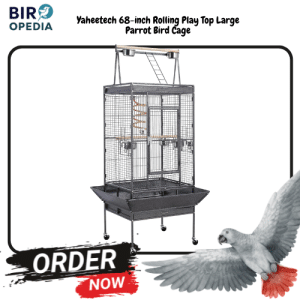
The Yaheetech 68-inch model is designed for social parrots that spend a significant amount of time interacting with their families. The standout feature is the rooftop playground, which saves space by combining a stand and a cage into one footprint.
Performance Analysis
This cage performs well as an all-in-one station. The play top includes a ladder and feeding bowls, which encourages your bird to stay active outside the cage while remaining in a designated “safe” spot. The 5/8-inch bar spacing is narrower than typical large parrot cages, making it exceptionally safe for Timneh Greys who might try to poke their heads through wider bars.
Build Quality & Ease of Use
The wrought iron construction is coated with a water-resistant finish, which is helpful for Greys who love to splash in their water bowls. It includes “Crescent” locks on the main door-a necessity because Greys are notoriously good at learning how to manipulate simple slide-latches.
Pros:
- Integrated Playtop: Provides an ascent ladder and perching area to maximize vertical space.
- Industrial Casters:Moves smoothly on carpet and hardwood, despite the weight.
- Seed Guard:The 4-sided flared guard is highly effective at catching the “shrapnel” from pellets and nut shells.
Cons:
- Interior Height: While the external height is 68 inches, the actual interior living space is 35 inches high, which may feel cramped for a large Congo Grey with long tail feathers.
- Assembly: Some users find the wheels difficult to seat correctly without extra tools.
Best For:
Active African Greys that spend several hours a day outside the cage and enjoy climbing.
Who Should Skip It:
Owners of very large Congo Greys who prefer a massive interior “flight” volume over a rooftop play area.
Prevue Pet Products Medium Dometop Bird Cage
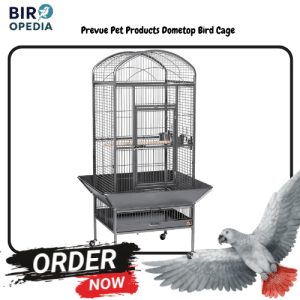
Prevue Pet Products is known for heavy-duty engineering, and the 34521 Dometop model is no exception. This cage prioritizes interior volume and security, making it a “fortress” for stronger birds.
Performance Analysis
The “Dometop” design adds significant vertical space compared to flat-top models. This extra headspace is ideal for hanging long shreddable toys or large swings. The bar spacing at 3/4 inch is the “gold standard” for medium-sized parrots, offering the perfect balance between visibility and safety.
Build Quality & Ease of Use
This is the heaviest of the three cages (58 lbs), utilizing 9 and 10-gauge wire. The “Multi-Lock” system, which includes a push-button lock and a wind-bell lock, is specifically designed to stop “escape artist” parrots. The stainless steel cups are “lock-in” style, preventing your Grey from flipping their food bowls over-a common parrot hobby.
Pros:
- Exceptional Security: Two-stage locking mechanism on the front door.
- Rounded Seed Guards: Unlike square guards, these are less likely to catch on your clothes or dent your walls.
- Structural Integrity: Heavy-gauge steel is much harder for a strong beak to bend.
Cons:
- No Playtop: The dometop is strictly for interior space; you cannot place items on top of it.
- Shipping Bulk: Due to the weight, the panels are susceptible to minor dings during transport that may require slight manual adjustment during assembly.
Best For:
Large Congo Greys and owners who value high-security locks and a larger interior “wing-stretch” area.
Who Should Skip It:
People looking for a lightweight, portable cage or those who need an integrated play station.
HSM 53-inch Wrought Iron Large Flight Cage
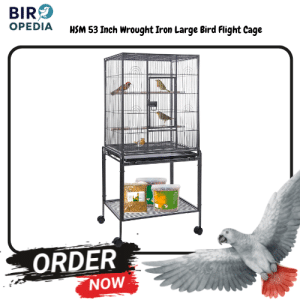
The HSM Flight Cage is a budget-conscious entry into the large bird category. While it is marketed for African Greys, its design leans more toward “flight” (width) for smaller species.
Performance Analysis
At 1/2-inch bar spacing, this is the narrowest spacing of the three. While this is incredibly safe against head-entrapment, the wire gauge is lighter than the Prevue or Yaheetech models. For a mellow bird, this works well; for a “chewer,” the bars may feel a bit flimsy.
Build Quality & Ease of Use
The cage features a flat-top design which allows you to place toys or a portable T-stand on top. It includes four feeding doors, though the feeding cups are noted by many users to be quite small-standard parrot-sized cups may need to be purchased separately for an African Grey’s appetite.
Pros:
- Value: Significantly lower price point than specialized parrot cages.
- Lightweight: At 29 lbs, it is very easy to move around the house for “change of scenery” time.
- Safety Grille: Keeps the bird from walking in its own waste and allows for tray cleaning without the bird escaping.
Cons:
- Narrow Depth: At 16.5 inches deep, a large African Grey may find it difficult to fully expand their wings without hitting the bars.
- Light-Duty Locks:The sliding feeder doors could potentially be opened by a smart, determined bird.
- Stability: The cage sits on top of the stand rather than being bolted in, which may feel less secure for a heavy bird leaping from perch to perch.
Best For:
Timneh African Greys, birds that are always “free-roaming,” or as a secondary sleeping cage in a separate room.
Who Should Skip It:
Congo African Grey owners or birds that are heavy chewers who might bend lighter gauge wire.
Buying Guide: How to Choose a Secure African Grey Habitat
Size and “Wing-Room” Requirements
An African Grey needs a cage that allows them to fully extend their wings and flap without touching the sides.
- Minimum Dimensions: Aim for at least 24″W x 22″D for Timnehs, and ideally larger for Congos.
- Depth Matters: African Greys are wide-bodied birds. Avoid cages with a depth less than 20 inches if they are spending more than 6 hours a day inside.
Bar Spacing and Wire Gauge
This is the most critical safety factor.
- Spacings: 5/8″ to 3/4″ is ideal. Anything wider than 1″ risks a Grey getting their head stuck.
- Gauge: Look for “Wrought Iron” or “Power-Coated Steel.” African Greys have a bite force of up to 400 PSI. They can snap or bend thin wire meant for finches or cockatiels.
Locking Mechanisms
African Greys observe their owners. They will watch you open the cage and attempt to replicate the motion.
- The “Bird-Proof” Standard: Look for crescent locks, push-button locks, or secondary “wind-bell” latches. Avoid simple gravity-based sliding doors.
Maintenance and Health
A cage should make your life easier, not harder.
- Seed Guards: These flared edges increase the cage footprint but reduce the time you spend vacuuming.
- Removable Grilles: Ensure you can pull out the waste tray without leaving a gap that the bird can slip through.
Frequently Asked Questions
What is the ideal bar spacing for an African Grey?
The ideal bar spacing is 3/4 inch. However, 5/8 inch is also very safe, particularly for smaller Timneh African Greys. You should generally avoid 1-inch spacing unless your bird is a very large Congo.
Is wrought iron or stainless steel better?
Stainless steel is the premium choice-it’s rust-proof and medical-grade-but it is very expensive. Wrought iron with a non-toxic powder coating (like the models reviewed above) is the most popular choice because it offers high durability at a mid-range price. Just ensure the coating is “lead and zinc-free.”
Should I get a play top or a dome top cage?
- Choose a Play Top if you want to save space and your bird enjoys being high up in the room to supervise family activities.
- Choose a Dome Topif you want to hang massive toys, swings, and climbing ropes inside the cage, as it provides better interior height.
Can an African Grey live in a flight cage?
Only if the flight cage is built with a heavy enough gauge. Many flight cages are meant for small birds like parakeets; African Greys need the “heavy-duty” version of these cages (like the HSM or Yaheetech) to ensure they don’t chew through the wire.
Final Recommendation
- If you have a large Congo African Grey and prioritize maximum security and interior space, the Prevue Pet Medium Dometop is the superior choice due to its 9-gauge wire and dual-lock system.
- For the social parrot that thrives on being the center of attention, the Yaheetech 68-inch Play Top offers the best functional value by providing a dedicated outdoor space.
- If you are on a strict budget or have a smaller Timneh, the HSM 53-inch Flight Cage is a serviceable entry point, though you may eventually want to upgrade as your bird matures and their chewing habits develop.
Finding the Right Sanctuary: Final Thoughts on African Grey Cages
Choosing a cage for an African Grey is a long-term commitment, often lasting 10 to 20 years or more. These birds aren’t just pets; they are high-intelligence companions who spend a significant portion of their lives within these wires. Your decision should prioritize structural safety and mental stimulation over aesthetics or price alone.
Balancing Space and Security
If your African Grey is a powerful “mechanical” bird that enjoys taking things apart, the Prevue Pet Dometop offers the most peace of mind. Its heavy-gauge wire and sophisticated locking system are specifically designed for the biting power of a Congo Grey. It prioritizes the interior “wing-room” that active climbers need.
On the other hand, the Yaheetech 68-inch Play Top is the superior lifestyle choice for birds that are integrated into the daily flow of the household. The rooftop playground encourages activity and keeps your bird at eye level, which can reduce the anxiety some Greys feel when kept lower to the ground. It is an excellent balance of value, space, and functionality.
The Realistic Budget Option
The HSM 53-inch Flight Cage is best viewed as a entry-level or secondary enclosure. While it offers a large footprint for a lower price, it lacks the specialized “parrot-proof” locks and heavy-duty thickness of the more expensive models. It is an excellent choice for a well-behaved Timneh or as a safe sleeping quarters, but it requires closer supervision for birds that are persistent escape artists.
Beyond the Bars
Remember that the cage is only the framework for your bird’s health. Regardless of which model you choose, your African Grey’s well-being depends on:
- A variety of perches: Swap the included dowels for natural wood or manzanita branches to prevent foot sores.
- Toy Rotation: Use the extra height in these cages to hang foraging and shreddable toys.
- Out-of-Cage Time: Even the largest cage is not a substitute for flight and interaction.
By matching the enclosure to your bird’s specific subspecies (Congo vs. Timneh) and their personal temperament, you aren’t just buying a cage—you’re providing a safe, comfortable home that supports their complex emotional needs.