
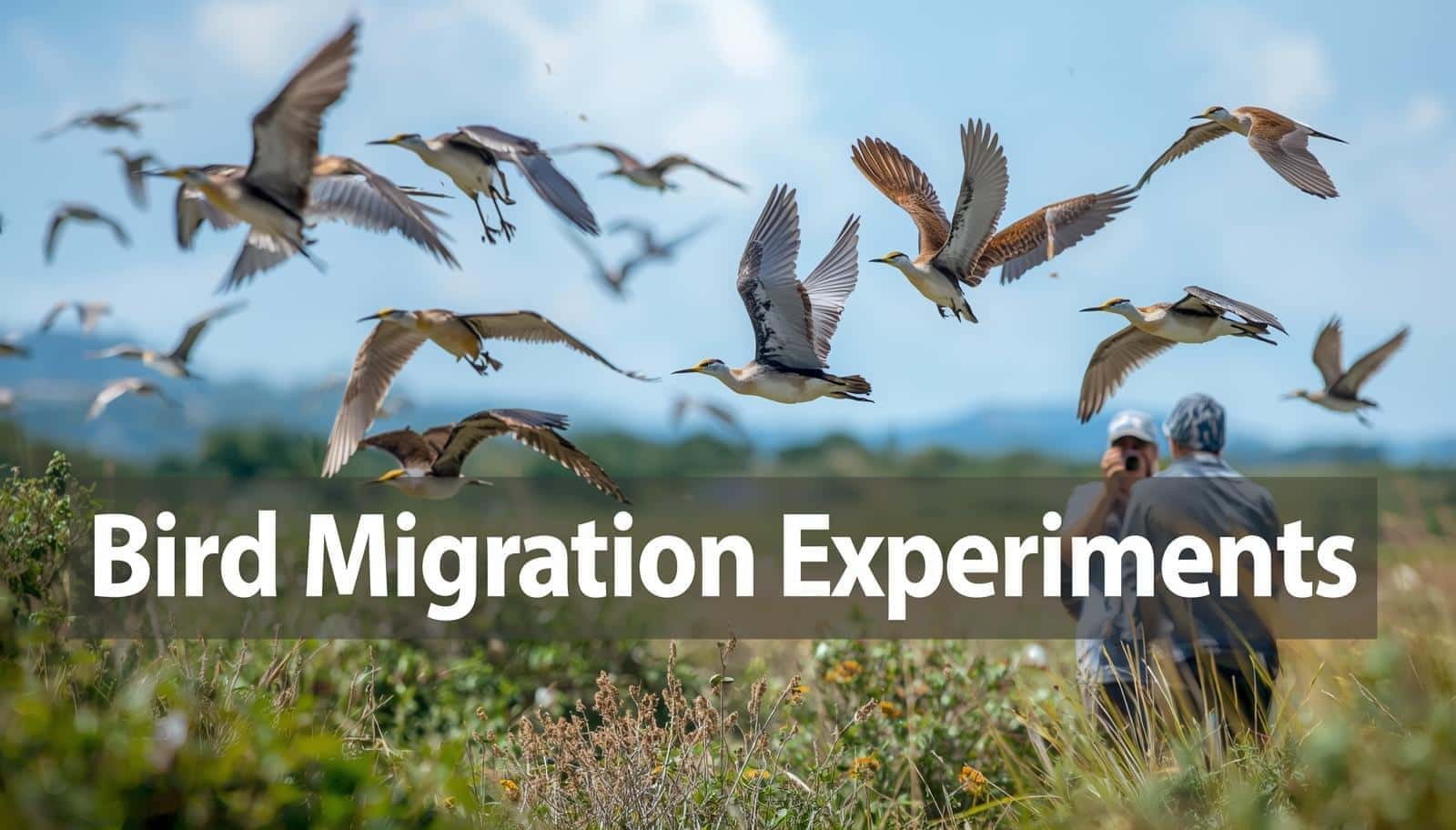
Have you ever wondered how birds know exactly when and where to fly thousands of miles during migration? What if you could uncover the secrets behind their incredible navigation skills?
Bird migration experiments reveal fascinating insights into how these creatures find their way across continents, facing challenges that would baffle most humans. By understanding these experiments, you’ll discover the hidden world of bird behavior and the surprising ways scientists unlock nature’s mysteries.
Keep reading, and you’ll see just how amazing and eye-opening these studies really are.

Credit: royalsocietypublishing.org
Bird Migration Basics
Bird migration is the regular movement of birds between breeding and wintering areas. Many birds travel thousands of miles every year. They do this to find food and better living conditions.
Scientists study bird migration to learn about how birds survive and adapt. This helps protect birds and their habitats.
Why Birds Migrate
Birds migrate mainly to find food and safe places to raise their young. The seasons change, and food becomes scarce in some places.
- To escape cold winters
- To find abundant food sources
- To breed in safe environments
- To avoid predators and harsh weather
Common Migration Routes
Birds follow specific paths called migration routes. These routes help them find food and rest stops. Many birds use the same routes every year.
| Route Name | Region Covered | Example Birds |
| Atlantic Flyway | East Coast of North America | Canada Goose, Osprey |
| Pacific Flyway | West Coast of North America | Sandhill Crane, Snow Goose |
| Central Flyway | Great Plains of North America | Swainson’s Hawk, Mallard |
| Mississippi Flyway | Along the Mississippi River | Wood Duck, Bald Eagle |
Types Of Migratory Birds
Birds migrate in different ways. Some travel long distances, and others move shorter distances. They can be grouped by how and when they migrate.
- Long-distance migrants: Travel thousands of miles between continents.
- Short-distance migrants: Move to nearby areas for food or weather.
- Altitudinal migrants: Move up and down mountains seasonally.
- Partial migrants: Only some members of the species migrate.
Early Migration Studies
Bird migration has fascinated scientists for centuries. Early studies helped us understand how birds travel long distances.
Researchers used simple methods to track birds and learn about their migration patterns.
Pioneering Experiments
One of the first experiments involved capturing birds and releasing them far from their homes. Scientists watched if birds returned.
These tests showed that birds have a strong sense of direction and can find their way back.
- Birds released miles away still returned home
- Scientists proved birds use natural cues
- Experiments helped start modern migration research
Historians cite the first valid experiment: “While many ancient theories existed, the first authoritative bird migration experiment is credited to Hans Christian Mortensen in 1899. This Danish teacher was the first to attach uniquely numbered aluminum bands to the legs of European Starlings. When these birds were later found in different countries, it provided the first irrefutable, scientific proof of specific migratory routes, birthing the modern practice of bird banding.”
Techniques And Tools Used
Early researchers used simple tools like rings and bands on birds’ legs. These helped identify birds when recaptured.
They also used maps and observations to record where birds traveled and when they moved.
- Metal bands with unique numbers
- Field notes on bird sightings
- Basic maps to plot migration routes
Key Discoveries
Early studies proved that many birds migrate seasonally to find food and better weather.
Scientists learned that birds use the sun, stars, and Earth’s magnetic field to navigate during migration.
- Bird migration follows predictable seasonal patterns
- Birds use natural cues for navigation
- Migration helps birds survive harsh climates
Modern Tracking Technologies
Tracking bird migration helps scientists learn about their routes and habits. New technology makes this work easier and more accurate.
Researchers use different tools to follow birds over long distances. These tools collect data on where birds go and how they travel.
Satellite Tracking
Satellite tracking uses small devices attached to birds. These devices send location data to satellites. Scientists get real-time information on bird movements.
This method works well for large birds that can carry the devices. It provides detailed maps of migration paths across continents.
Geolocators And Gps
Geolocators record light levels to estimate bird locations. They are light and small, so birds can carry them easily.
GPS devices give exact coordinates by connecting to satellites. They need more power but provide very accurate data.
- Geolocators are good for long trips with less detail.
- GPS devices give precise location but need more battery.
- Both tools help study migration timing and stopover spots.
Data Collection Methods
Scientists collect migration data using different methods. They choose based on bird size and study goals.
| Method | Use | Advantages |
| Satellite Tracking | Large birds | Real-time, wide coverage |
| Geolocators | Small birds | Lightweight, long battery life |
| GPS Devices | Medium to large birds | High accuracy, detailed routes |
Credit: defenders.org
Navigation Mechanisms
Bird migration is a long journey between breeding and wintering areas. Birds use special skills to find their way over large distances.
Scientists study bird migration to learn how birds navigate. They focus on three main ways birds find their path.
Magnetic Field Sensing
Birds can sense the Earth’s magnetic field to guide their migration. This sense acts like a natural compass inside their bodies.
Special cells in a bird’s brain or eyes help detect magnetic signals. These signals tell the bird which direction to fly.
- Quantum biologists propose a mechanism: “The leading theory for how birds ‘see’ the Earth’s magnetic field involves a protein in their eyes called cryptochrome. When light hits this protein, it creates a pair of quantum entangled electrons. The alignment of these electrons is sensitive to the Earth’s magnetic field, potentially allowing the bird to perceive magnetic north as a visual overlay—a literal heads-up display of direction.”
Celestial Navigation
Birds use the sun and stars to find their way during migration. They know the position of the sun during the day.
At night, birds look at star patterns to stay on course. They remember the position of bright stars to guide them.
Landmark Recognition
Birds remember large landmarks like mountains, rivers, and coastlines. These landmarks help birds navigate near the ground.
Birds use landmarks to check their position and adjust their flight path. This helps them avoid getting lost on their journey.
Environmental Influences
Bird migration experiments show how the environment affects birds’ travel. Scientists study many factors that change their routes and timing.
Understanding these influences helps protect birds and their habitats during migration seasons.
Weather Impact
Weather plays a big role in bird migration. Strong winds can help or stop birds from flying.
Rain and storms make birds wait for better conditions. Temperature changes also affect when birds start migrating.
- Wind direction guides flight paths
- Storms cause delays or changes
- Cold snaps may speed up migration
- Warm weather can delay departure
Climate Change Effects
Climate change shifts the timing of seasons. Birds may arrive too early or late at their destinations.
Warmer temperatures can change food availability. This forces birds to adapt or face risks during migration.
- Earlier springs change migration start
- Food sources may disappear or move
- New predators or diseases may appear
- Some birds may change routes
Habitat Alterations
Human activities change bird habitats along migration paths. Urban growth and farming reduce resting spots.
Loss of wetlands and forests affects food and shelter. Birds may struggle to complete long journeys safely.
- Deforestation cuts key stopover areas
- Wetland drainage removes feeding grounds
- Light pollution confuses night migrants
- Pollution harms food quality
Conservation Efforts
Bird migration experiments help us learn about the routes birds take. This knowledge supports conservation efforts to protect these birds.
Conserving migratory birds needs teamwork from many groups. Scientists, governments, and communities all play a role.
Protecting Migration Corridors
Migration corridors are paths birds use to travel long distances. Protecting these routes keeps birds safe from dangers.
Conservationists work to keep these areas free from pollution and habitat loss. They also create safe resting spots for birds.
- Preserve forests and wetlands along routes
- Reduce light and noise pollution
- Create bird-friendly parks and reserves
International Cooperation
Birds cross many countries during migration. Countries must work together to protect birds on their journeys.
International agreements help share information and fund projects. This teamwork improves bird safety across borders.
- Share data from bird tracking experiments
- Coordinate protection laws between countries
- Support global bird monitoring programs
Community Involvement
Local communities help by watching birds and reporting data. Their actions can protect birds in their area.
Education programs teach people about bird needs. Communities build birdhouses and avoid harmful chemicals.
- Participate in bird counting events
- Create safe habitats in gardens and parks
- Support local wildlife conservation groups
Future Research Directions
Bird migration experiments help us learn how birds travel long distances. Scientists want to find new ways to study these journeys.
Future research will use new tools and ideas. This can help answer questions and find new facts about migration.
Emerging Technologies
New tools make tracking bird migration easier and more detailed. Mini GPS devices can be attached to small birds without harm.
Drones and satellites give a wider view of migration paths. Artificial intelligence helps analyze large amounts of data quickly.
- Miniature GPS and radio trackers
- Drones for aerial monitoring
- Satellite imaging
- Artificial intelligence for data analysis
Unanswered Questions
Scientists still do not know how birds choose exact routes. The role of weather and magnetic fields needs more study.
How birds rest and find food during long flights is not fully understood. The effects of climate change on migration are also unclear.
- How birds navigate precise paths
- Impact of weather and magnetic fields
- Resting and feeding habits during migration
- Effects of climate change on migration
Potential Breakthroughs
Better tracking can show new migration routes. Understanding bird navigation can improve conservation efforts.
Studying migration may help predict how birds adapt to changing environments. This knowledge can protect bird species in the future.
- Discovery of unknown migration paths
- Improved bird conservation methods
- Insights on adaptation to climate change
- Better understanding of bird navigation

Credit: www.mdpi.com
Frequently Asked Questions
What Are Bird Migration Experiments?
Bird migration experiments study how and why birds travel seasonally. Researchers track routes, timing, and navigation methods to understand migration behavior better.
How Do Scientists Track Migrating Birds?
Scientists use GPS tags, radio transmitters, and banding to monitor birds’ migration paths. These tools provide accurate data on flight routes and stopover sites.
Why Are Bird Migration Experiments Important?
These experiments reveal migration patterns, helping protect habitats and guide conservation efforts. They also improve knowledge of climate change impacts on birds.
What Techniques Are Used In Bird Migration Experiments?
Common techniques include satellite tracking, radar monitoring, and genetic analysis. These methods help identify migration routes, stopover points, and population dynamics.
Conclusion
Bird migration experiments reveal fascinating insights. Birds navigate vast distances. They rely on stars, landmarks, and Earth’s magnetic field. These studies help us understand their journey better. Scientists learn more about their amazing adaptations. This knowledge supports bird conservation efforts worldwide.
Protecting habitats is crucial for their survival. Observing their migration patterns offers valuable data. It enriches our understanding of nature’s wonders. These experiments remind us of nature’s complexity. And its beauty. So, cherish and protect our feathered travelers. They play vital roles in ecosystems.
Their journeys inspire awe and respect. Let’s continue exploring and protecting these incredible creatures.



