Ultimate Bird Cage Stand Buying Guide: Evaluating the Garvee 66-inch Play Center
Deciding how to elevate your parrot’s home is about more than just height; it is about providing a safe, mobile, and interactive “home base” for their daily activities. Whether you are transitioning from a table-mounted setup or seeking an all-in-one out-of-cage enrichment station, understanding the mechanics of a reliable support system is essential for your bird’s physical and psychological health.
In this transactional evaluation, we dive into the specifications, assembly realities, and structural performance of modern standing activity centers. Our primary focus is the Garvee 66-inch Birdcage Stand Activity Play Center, a product that has gained traction for its large footprint and multi-level enrichment design.
This Bird Cage Stand Buying Guide is engineered to help you determine if this specific heavy-duty solution provides the long-term value your feathered family deserves.
Technical Performance Analysis: The Garvee 66-inch Activity Stand
Selecting the best bird cage stand involves analyzing more than just aesthetics. For owners of medium and large parrots, the stability of the frame during vigorous climbing or wing flapping is the primary safety metric.

Buy Now Bird Playstand, 66 in H Inch Birdcage
Core Specifications Teardown
The Garvee 66-inch unit is constructed primarily from metal with a hammered black finish designed for scratch resistance.
| Feature | Detailed Measurement | Practical Buying Implication |
| Total Height | 66 inches | Places bird near human eye level for better socialization. |
| Total Width | 33 inches | Wide enough for full wing extension for African Greys or Conures. |
| Depth | 23 inches | Slim enough for most hallways while remaining stable. |
| Weight | 46 pounds | High enough mass to prevent tipping by active birds. |
| Frame Material | Heavy-duty Steel | Withstands chewing and aggressive play. |
| Perch Diameter | Largest is 0.98 inch | Appropriate for Conure to medium Cockatoo foot sizes. |
Build Quality and Stability
The structural integrity of this bird cage stand relies on its wide rectangular base and low center of gravity. A recurring theme in product evaluation is the necessity for weight distribution; by placing the storage shelf at the bottom, the center of gravity is lowered, making the unit far less prone to tipping during a sudden takeoff or a climbing surge.
The carbon steel frame is treated with a hammered paint finish. In praktice, this provides a tactile surface that is easier for birds to grip when climbing the exterior, while offering superior resistance to rust in humid indoor environments compared to standard flat-paint steel models.
Detailed Evaluation of Daily Enrichment Features
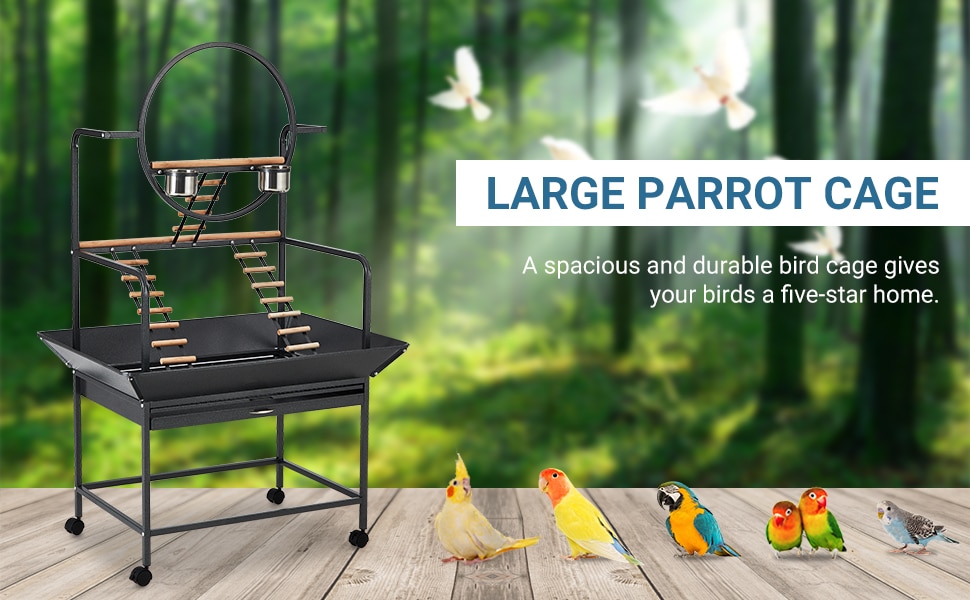
A premium bird cage stand for parrots must go beyond being a furniture pedestal; it should function as a gymnasium. The Garvee unit excels here with a tiered interaction system.
1. Multi-Level Ladder Configuration
The play center features three distinct wooden ladders. This angled orientation encourages natural vertical climbing behaviors, which provides essential cardiovascular exercise for species prone to obesity, such as Amazons or Cockatoos. Evidence suggests that having staggered heights helps multiple birds find their own territory on the stand, reducing potential flock squabbles during free-roaming time.
2. Specialized Play Hoop (Interactive Ring)
A defining characteristic of this model is the integrated center circle. This 360-degree territory serves as a secure landing pad and an attachment point for additional hanging toys. One buyer suggested that adding a stainless steel eyebolt to the top of the ring allows for better stimulation, as parrots love hanging bells and foragers in the center of their activity space.
3. Stainless Steel “Safe-Feeding” System
Plastic cups are a significant hazard for large parrots, as they can be shredded and ingested. The dual stainless steel bowls included here are diswashers-safe and hygienic. The “swivel” feeding system means owners can access bowls for food and water refills from the exterior, which minimizes disruption if a bird is particularly protective of their play zone.
4. The Integrated Bottom Shelf
Storage is often an afterthought, but this bird cage stand with storage helps keep bulky seed bags, spare perches, and cleaning sprays in one localized spot. Having an open-access shelf means you aren’t searching through cabinets for emergency supplies when your bird makes a localized mess.
Real-World Usability: Maintenance and Assembly Concerns
Trust in a product comes from acknowledging its limitations. Every piece of equipment has “frictions” during daily use that an experienced researcher should note before a buyer clicks “Purchase.”
Hygiene and The Cleaning Teardown
Birds are notoriously messy. The Garvee unit addresses this with two layers of debris control:
-
The Rounded Seed Guard: This flared metal “skirt” surrounds the central tray. It is designed to catch falling seed hulls and dross before they reach your flooring. Note that while this is highly effective, the metal corners on these guards can be sharp; we suggest checking that all edges are smooth during setup to prevent catching your clothing.
-
Detachable Slide-Out Tray: The main waste drawer slides out smoothly without requiring you to disturb the bird perched above. This encourages daily liner changes, which is the most effective way to prevent bacterial growth.
The Assembly Reality Check
For many owners, an easy-to-assemble bird cage stand is the top requirement. Our research shows a discrepancy here. While the components fit together securely once built, multiple verified users report that the instruction manuals lack text descriptions, relying solely on small diagrams.
-
Assembly Tip: Layout all hardware (screws and bolts) and label them based on length before beginning.
-
Time Commitment: Expect between 60 and 90 minutes for a single person to complete the setup. Having a second pair of hands to hold the arched ring and side panels will dramatically reduce assembly frustration.
-
Tools: Use your own #4 hex wrench or a powered driver with a light setting rather than the small included hand tool for a more secure finish.
Buyer Selection Framework: Matching the Stand to the Bird
Identifying your bird’s species is the most critical part of this Bird Cage Stand Buying Guide. Use the framework below to match your needs.
Ideal Fit: Small-to-Medium Active Species
Owners of Cockatiels, Sun Conures, Quakers, and Caiques often describe this stand as “Bird Paradise.” The ladder spacing and perch diameters (under 1 inch) are perfectly scaled for these smaller feet. The vertical height also satisfies the “lookout” instinct common in Conures, who love to survey their room from a high point.
The Medium Parrot Standard
If you need an African Grey cage stand or a home base for an Eclectus, the Garvee 66-inch is a viable choice. The stability of the carbon steel frame holds up well to the 400-gram mass of an adult Grey. One owner noted that her Grey looks “tiny” on this stand, indicating that there is ample room for them to turn around and play without hitting their tail on the metal ring.
Large Parrot Warning (Macaws and Cockatoos)
Can you use this as a macaw cage stand? The evidence is mixed. While the product is described as “heavy-duty” and user “Brandie” stated her Macaw “loves the stand,” others have found that determined chewers like Blue and Gold Macaws can eventually chip away at the stairs or ladder wood. If your parrot has high “beak pressure,” you may need to plan for eventually replacing the included dowel ladders with harder manzanita or coffee wood perches.
Bird Cage Stand Comparison: Garvee vs. Standard Bases
To finalize your transaction decision, compare the functionality of an activity center versus a standard rectangular stand.
| Metric | Garvee Activity Center | Standard Steel Stand |
| Occupancy Space | Large Activity Volume | Minimal foot-print |
| Social Function | Independent out-of-cage play | Purely supporting an existing cage |
| Mobility | 360° Ball Casters | Often plastic single-wheels |
| Feeding Access | Included External Bowls | No feeders included |
| Storage Potential | Bottom Storage Shelf | Varies widely |
Owners prioritizing floor area often look for a space-saving bird cage stand that hugs a wall. While the Garvee unit has a 33-inch width, it functions better as a “central piece” rather than something tucked behind a sofa. However, if your bird spends more than 50% of their day outside the cage, this playstand actually saves space by eliminating the need for a separate tabletop T-perch and various food dishes on your kitchen counter.
Purchasing Factors to Consider
Before finalizing your order, ask yourself three qualifying questions to ensure you avoid “buyer’s remorse.”
-
Floor Type: Do you have deep shag carpet or tile? The 4 locking swivel casters perform best on hard surfaces, allowing the heavy duty bird cage stand with wheels to glide smoothly for room-to-room cleaning.
-
Destructive Habits: Does your bird destroy wooden dowels within hours? If so, consider the cost of adding stainless steel hanging perches to the ring to replace the wood ladders over time.
-
Space Alignment: Does a 33-inch width allow you to move the stand between your bird room and the living room without hitting door jambs? Measure your interior doors to ensure it functions as a mobile station.
Many people search for a parrot cage stand looking for a bargain. While the Garvee sits at an attractive price point for its size, users should prioritize its activity value over its storage volume. The affordable bird cage stand price tag comes from using simplified bolt patterns, so ensuring you tighten those bolts completely during assembly is non-negotiable for long-term durability.
FAQs: Important Pre-Purchase Questions
Can the wheels be locked for active sessions?
Yes. The caster system includes two wheels with high-friction brakes. This is vital because if a bird like an African Grey hops off or onto the stand vigorously, an unlocked stand will “walk” across tile floors, potentially causing fear or instability for the bird.
Is the metal finish non-toxic?
Yes. It uses a non-toxic hammered paint finish that is safe for hookbills that like to explore the frame with their tongues. However, as with any metal cage accessory, routine wiping to remove food acidity prevents the finish from wearing down prematurely.
Can I hang my own toys from the arched top?
Absolutely. Most bird cage stand reviews for this model emphasize that the “circle territory” is the perfect place for forager boxes and preening ropes. One tip is to add some cotton flexible rope over the top of the ring so the metal isn’t too “cold” for their feet during long nap sessions.
Where is the best place to keep this in the house?
For a durable bird cage stand like this one, place it in a corner of a main living area where you spend time. Being 66 inches tall, it provides a safe, high perch where your bird can feel included in family activities while having its own secure food and water supply.


Conclusion: Final Advice for Selection
Investment in an activity center is an investment in your parrot’s longevity. This Bird Cage Stand Buying Guide highlights that a good stand is not merely a pedestal, but a versatile ecosystem for physical health.
Final Buying Verdict:
-
Buy this stand if: You have a mid-sized bird (Cockatiel to Grey) and need an all-in-one out-of-cage gym that is easy to move and simple to sanitize. The 33-inch width and tiered ladders offer the best enrichment for your dollar.
-
Skip this stand if: You cannot follow diagram-only instructions or have a 2-pound Macaw that requires solid industrial-gauge materials and massive bar spacing for safety.
Providing an interactive habitat outside the main cage significantly reduces stress and unwanted screaming behaviors. By choosing a steel bird cage stand with integrated perches, you provide your companion with a permanent place of belonging within your home. Ensure you leverage the bird cage stand with storage shelf to keep your home tidy and follow the assembly advice to create a sturdy sanctuary that lasts for years.
Choosing correctly requires balancing your bird’s wingspan with the physical constraints of your home, but the social reward of an integrated playstand is truly unmatched. We recommend performing a monthly bolt check to ensure everything remains “rock-solid” as your parrot enjoys its new five-star home. Following the principles in this Bird Cage Stand Buying Guide ensures your purchase remains a secure, mobile, and loved fixture in your flock’s life.