
Have you ever wondered how birds find their way when the sky is covered with thick clouds? Without clear sunlight or visible landmarks, their navigation seems almost like magic.
But there’s a fascinating science behind How Do Birds Navigate in Cloudy Weather, even when the sun and stars are hidden. Birds rely on natural systems that help them stay on course despite poor visibility.
If you want to discover the secrets birds use to guide themselves through cloudy skies, keep reading—you’ll be amazed at how nature solves this mystery.
Bird Navigation Basics
Birds use many ways to find their way during flights. They travel long distances to reach their homes or feeding places.
Understanding how birds navigate helps us learn about nature and animal behavior.
Common Navigation Techniques
Birds use several methods to know where to go. These include using the sun, stars, earth’s magnetic field, and smells.
- Sun Compass: Birds use the sun’s position during the day.
- Star Compass: At night, birds follow star patterns.
- Magnetic Sense: Birds sense Earth’s magnetic field to guide them.
- Olfaction: Some birds use smells to find their way.
- Landmarks: Birds remember mountains, rivers, and coastlines.
Role Of Visual Cues
Visual cues are very important for birds. They help birds stay on track, especially in clear weather.
| Visual Cue | How It Helps |
| Mountains | Birds use shapes to guide their direction. |
| Rivers | Rivers act as natural pathways. |
| Coastlines | Birds follow coastlines to avoid getting lost. |
| Forests | Forests provide landmarks for navigation. |

Credit: freerangestock.com
Challenges Of Cloudy Conditions
Birds use the sun and stars to find their way during migration. Cloudy weather blocks these important guides.
Without clear skies, birds face many challenges. They must rely on other senses and methods to navigate.
Obscured Sun And Stars
Clouds hide the sun and stars, which birds use like a map and compass. This makes it hard to keep their direction.
- Birds cannot see the sun’s position during the day.
- Stars become invisible at night under thick clouds.
- Cloud cover can last for hours or days, increasing navigation difficulty.
- Some birds use magnetic senses more when visual cues are missing.
Impact On Visual Landmarks
Birds also use trees, rivers, and mountains to find their route. Clouds reduce visibility of these landmarks.
| Visual Landmark | Effect of Clouds |
| Mountains | Often hidden by fog and clouds |
| Rivers | Harder to spot from high altitude |
| Forests | Appear less distinct in low light |
| Coastlines | Blurred or invisible in heavy cloud cover |
Magnetic Compass In Birds
Birds travel long distances during migration. They find their way even on cloudy days. One tool they use is the Earth’s magnetic field. Birds have a natural magnetic compass. This helps them know which way to fly.
The magnetic compass in birds works inside their bodies. It gives them a sense of direction. Scientists study how birds sense this magnetic field. They want to understand the exact process.
How Birds Sense Earth’s Magnetism
Birds sense Earth’s magnetism using special cells. These cells act like tiny compasses. They detect the magnetic field around the bird. This helps the bird know its position.
Some birds have these cells near their eyes. Others have them in their beaks. These cells send signals to the bird’s brain. The brain then guides the bird’s flight path.
- Magnetic sensors are in bird’s eyes or beaks
- Cells detect magnetic field direction
- Signals travel to the brain for navigation
Magnetoreception Mechanisms
Magnetoreception is the ability to detect magnetic fields. Birds use two main ways to sense magnetism. One uses tiny iron particles. The other uses light-sensitive proteins.
Iron particles work like a compass needle inside the bird. They move with the magnetic field. Light-sensitive proteins change their behavior when exposed to magnetic fields. This helps birds see magnetic directions.
- Iron particles act as a natural compass inside birds
- Light-sensitive proteins respond to magnetic fields
- Both help birds know direction without seeing the sun

Credit: www.reddit.com
Use Of Atmospheric Cues
Birds use many natural signals to find their way. Atmospheric cues help them navigate in cloudy weather.
These cues include changes in air pressure and wind patterns. Birds sense these to stay on course.
“Geophysicists note that birds can hear infrasound—low-frequency sound waves created by ocean waves, mountains, and storms—that travel for thousands of kilometers. This allows a bird flying in a cloud to ‘hear’ a mountain range or a storm hundreds of miles away, effectively giving them a sonar map of the terrain ahead.”
Detecting Air Pressure Changes
Birds can feel when air pressure changes around them. This helps them know if weather is good or bad for flying.
Low pressure often means storms, so birds may change their route or stop flying. High pressure means clear skies and safe travel.
- Birds sense pressure with special sensors in their bodies.
- Pressure changes guide birds to safer or better paths.
- This skill helps birds avoid bad weather when clouds block the sun.
Sensing Wind Patterns
Birds feel wind direction and strength while flying. This helps them adjust their flight path during cloudy weather.
They use wind to save energy by gliding and soaring. Understanding wind patterns also helps birds keep their direction.
- Birds detect wind changes with their feathers and body.
- They use tail and wing movements to stay balanced in wind.
- Wind sensing helps birds avoid strong gusts or storms.
Olfactory Navigation
Birds use many ways to find their way in cloudy weather. One key way is by smell. This is called olfactory navigation.
Even when they cannot see the sun or stars, birds can follow scents in the air. These smells help them know where to go.
Smell As A Navigational Aid
Birds have a strong sense of smell. They can detect odors from far away. This helps them recognize places and directions.
They learn to associate certain smells with locations. For example, the smell of the sea or forests guides them during flight.
Examples In Different Bird Species
Some bird species rely more on smell than others. Here are a few examples showing how they use olfactory navigation.
- Homing pigeons: Use smells from their home area to find their way back.
- Petrels and albatrosses: Detect ocean smells to locate food and nesting sites.
- Turkey vultures: Follow smells of decaying animals to find food.
Social And Learned Navigation
Birds use many ways to find their way in cloudy weather. They cannot see the sun or stars. So, they rely on social and learned navigation skills.
These skills help birds travel safely by following others and remembering routes from past trips.
Following Experienced Birds
Young or less experienced birds often follow older birds. These leaders know the right path even when the sky is cloudy.
By flying together, birds share knowledge and stay on course as a group.
- Experienced birds guide the group
- Less experienced birds learn the route
- Groups stay together for safety
- Following reduces the risk of getting lost
Memory And Route Learning
Birds remember landmarks and directions from past trips. This memory helps them navigate when they cannot see the sun or stars.
They use these learned routes to find their way back home or to feeding sites during cloudy weather.
- Birds recall trees, rivers, and mountains
- They learn routes over many trips
- Memory helps in poor weather
- Learned navigation improves with practice
Technological Studies On Bird Navigation
Birds use many ways to find their path, even in cloudy weather. Scientists study how birds travel without clear skies. Technology helps track birds and learn their hidden ways to navigate.
This research shows how birds use tools inside their bodies and the environment. It also reveals how they adapt when the sun or stars are not visible.
Tracking Devices And Data
Scientists attach small trackers to birds to follow their journeys. These devices collect data on location, speed, and altitude. The data helps researchers see bird routes during cloudy weather.
GPS trackers and tiny sensors give detailed information about how birds move. Data shows that birds can fly long distances without clear skies. This technology improves our understanding of bird travel.
- GPS trackers record exact bird positions
- Accelerometers measure bird movement and speed
- Data helps map routes in bad weather
Revealing Hidden Navigation Strategies
Technology uncovers how birds use Earth’s magnetic field to find their way. Birds sense magnetic signals to guide themselves when they cannot see the sun or stars. This magnetic sense works even on cloudy days.
Other tools show that birds use sound and smell to help navigate. Some birds listen to ocean waves or use smells carried by the wind. These hidden strategies make bird navigation very complex.
- Magnetic field sensing guides birds in low visibility
- Birds use sounds from nature as navigation clues
- Smell helps birds find familiar areas during migration
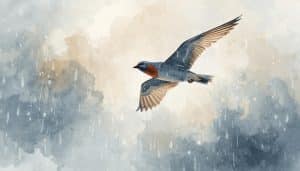
Credit: www.vecteezy.com
Frequently Asked Questions
How Do Birds Navigate Without The Sun?
Birds use Earth’s magnetic field to navigate in cloudy weather. They have magnetoreception, a sense that allows them to detect magnetic fields. This helps them maintain direction even when the sun or stars are not visible. Additionally, birds rely on landmarks and environmental cues for guidance.
Can Birds Fly In Heavy Clouds?
Yes, birds can fly in heavy clouds. They rely on their magnetic sense, experience, and environmental cues. These abilities help them maintain course. Birds have evolved to handle various weather conditions, allowing them to travel long distances successfully.
What Senses Help Birds Navigate In Clouds?
Birds use multiple senses to navigate in clouds. They rely on their magnetic sense, visual landmarks, and environmental cues. These combined abilities allow them to maintain direction and reach their destinations even when visibility is low.
Do Birds Get Lost In Foggy Weather?
Birds can experience disorientation in foggy weather, but rarely get lost. They rely on their magnetic sense and environmental cues. These abilities help them regain their bearings and continue their journey successfully.
Conclusion
Birds use many tools to find their way in clouds. They rely on Earth’s magnetic field and sense of smell. Even without the sun or stars, they stay on course. Their strong instincts help them navigate through the fog. Nature equips birds with amazing skills for tough weather.
This shows how well birds adapt to survive. Watching birds fly through clouds is truly impressive. Their navigation is a mix of science and nature’s wonder.